About: Juana Alicia: Resumé
RESUME
CREDENTIALS AND DEGREES
Masters in Fine Arts, Drawing and Painting, San Francisco Art Institute, May 1990
B.A. in Teaching Aesthetic Awareness from a Cultural Perspective, University of California at Santa Cruz, 1979
Single Subjects Credential in Art Education, 1980
Bilingual Cross-Cultural Emphasis Credential, U.C.S.C., 1979
Fifth Year Certificate in Bilingual Education, 1983
Passed the CBEST (California Basic Educational Skills Test), 1998
RECOGNITION
National Endowment for the Humanities, BIRTH MURAL Best Visual Art Work with a Chicano/Mexicano Theme, through the University of California, Santa Cruz, 1982.
Precita Eyes Mural Arts Center, Master Muralist Award, 1992.
Distinguished Visiting Professor, Oakes College, University of California, Santa Cruz, 1992.
NACS (National Association of Chicano Studies), for Outstanding Contributions to the Arts, Academia and Our Communities, 1993.
Woman of Fire Award, Women of Color Resource Center, Berkeley, Ca 2000.
California State Senate, Outstanding Contributions as an Oakland Arts Educator, 2004.
Residency at Windcall Ranch, Belgrade. Montana, 1999. Windcall is a retreat program for environmental and social justice activists who have worked in their field for at least five years and are in earnest need of a break.
Fulbright Fellowship, Escuela Superior de Arte de Yucatán (ESAY), Visiting Professor in Mural Arts/Painting, 2006-2007.
SELECTED PUBLICATIONS
Street Art San Francisco: Mission Muralismo, Precita Eyes Mural Art Center, Harry Abrams, 2009.
Mujeres de Conciencia/Women of Conscience, Victoria Alvarado, Floricanto Press, 2007.
Kiriakos, Iosifidis, Mural Art: Murals on Huge Public Surfaces Around the World, Publikat, 2008.
Walls of Empowerment: Chican/o Indigenist Murals of California, Guisela Latorre, University of Texas Press, Austin 2008
Chicana Art: The Politics of Spiritual and Aesthetic Altarities, Laura Perez, Duke University Press, 2007
Stop the Next War Now: Effective Responses to Violence and Terrorism, Co-Authors: Medea Benjamin and Jodie Evans, Chapter 10: Celebrate Joyful Revolution, Picture Peace, Juana Alicia, 2007, Published by Code Pink.
Triumph of Our Communities, Gary D. Keller et al, Bilingual Press/Editoria Bilingue, Tempe, Arizona, 2005.
Art, Women and California, “Other Landscapes”, Angela Y. Davis, 2000.
Imagine: International Chicano Poetry Journal, Volume 3, 1986, Imagine Publishers
Feminist Geographies: Explorations in Diversity and Difference, Women and Geography Study Group of the Royal Geographical Society with the Institute of British Geographers, Addison Wesley Limited, 1987
Yesterday and Tomorrow, California Women Artists, Edited by Sylvia Moore, Midmarch Press,
1989
Cover Image, Signs from the Heart: California Chicano Murals, SPARC, The Social and Public Arts Resource Center. 1990
Paper Angels and Bitter Cane, Two Plays by Genny Lim, Kalamaku Press, 1991, cover artwork.
Chicano Art: Resistance and Affirmation, 1965-1985, Wight Art Gallery, UCLA, 1991
Barrio, George Ancona, 1995
Regeneration, Galeria de la Raza, Armando Rascon, Curator. February 1995
Homeless Not Helpless, An Anthology Edited by Barbara Paschke and David Volpendesta, 1991
Reconceptualizing the Peasantry: Anthropology in Global Perspective, by Michael Kearny, Westview Press, a division of Harper-Collins, 1996.
Border Matters: Remapping American Cultural Studies, by Jose David Saldivar, University of California Press, 1997, cover artwork.
Feminist Geographies: Explorations in Diversity and Difference, Women and Geography Study Group, Addison Wesley Longman Limited 1997, cover artwork.
San Francisco Murals, by Timothy W. Drescher, Pogo Press, 1998
Painting the Towns, by Jim Prigoff and Robin Dunnitz, RJD Enterprises, 1999, back cover image,
We Are the Ones We’ve Been Waiting For, Women of Color Organizing, front cover, edited by Rinku Sen, U.S. Urban Rural Mission, 1999.
EDUCATOR
2007-2010 Berkeley City College, Full-time Instructor, Visual Art.
2006-7 Escuela Superior de Arte de Yucatán (ESAY), Visiting Professor in Mural Arts/Painting, Fulbright Fellowship.
2005 Lecturer for SPEAK OUT-Institute for Democratic Education and Culture. “SPEAK OUT!- works with 200 speakers and artists who represent the breadth of social movements as well as critically-acclaimed exhibits and films which inform and empower young people to take action for positive social change.”speakoutnow.org
2004 Oxbow School, Napa California. Artist in Residence, Summer Program: “Serious Art, Serious Fun”
2002-2003 University of California, Davis, Chicano Studies, Visiting Lecturer: “Introduction to Chicano Studies.”
2002-2004 San Francisco State University: “ Raza Art History”, “ Community Narratives”, “Mexican Art History” and “Women as Creative Agents” (College of Ethnic Studies and Women’s Studies).
2001-2002 University of California, Davis, Chicano Studies, Visiting Lecturer: “Chicanas, Politics and Public Policy” and “Political Economy of Chicano/Latina Communities”
San Francisco State University, College of Ethnic Studies and Department of Women’s Studies, Visiting Lecturer:“Raza Art History”, “Raza Oral History and Tradition” and “Woman as Creative Agent”
California State University at Hayward, supervisor for student teachers. Berkely Arts Magnet, visual art teacher. Public speaker for Speak Out, a progressive speaker’s bureau. Richmond Art Center, Art 10 Program, Richmond, CA,
2000 Stanford University, Visiting Professor, Department of Spanish and Portuguese: Chicana/Xicano Muralism.
1995-99 Co-Founder and Co-Director, The East Bay Institute for Urban Arts, Oakland, CA.
1994-5 Atelierista (resident art teacher) at the San Francisco Charter Early Childhood School.
1990-5 Core faculty, New College of California, graduate and undergraduate Visual Arts Coordinator of undergraduate Interdisciplinary Art and Social Change Program.
1992 Distinguished Visiting Professor, Oakes College, University of California, Santa Cruz.
New College of California, Core Faculty in Drawing and Visual Arts Program Coordinator.
1990-93 California College of Arts and Crafts, classes in drawing, Latin American history and mural painting.
1990-95 New College of California, classes in drawing and Latin American art history. Coordinator of Visual Arts Program, Fall
1990 San Francisco Art Institute, Watercolor, spring extension program.
1989 San Francisco Art Institute, Watercolor, summer extension program.
1989 California Arts Council, Artist in Residence, Artist in Schools Grant for Hawthorne Elementary School, San Francisco.
1987 California Arts Council, Artist in Communities Grant for 1987- 88, at the Hispanic Cultural Center of Novato and World College West.
1985 Artist in Residence at La Raza Graphics for one year, in various student mural projects, both at the La Raza site and at Good Samaritan Community Center.
1985 Directed student mural project at the Mission Pool and Playground. 19th and Linda Streets, San Francisco. Worked in collaboration with aforementioned colleagues.
1984 Directed high school student mural project through the State Department of Migrant Education’s Yo Puedo Program at Stanford University: Assisted students in design and execution of mural at Stanford’s Chicano Centro.
Artist in Residence at Potter Valley School. Potter Valley, California, directing mural project with forty elementary school students. Painted 1,000 square foot Politec mural on exterior wall of school.
1981 Taught art to elementary and secondary level migrant students in a two-year program designed and administered by the artist (funded through the State Office of Migrant Education) in Pájaro, California, featuring workshops in ceramics, drawing, design and mural painting.
1985 Artist in Residence at La Raza Graphics for one year, in various student mural projects, both at the La Raza site and at Good Samaritan Community Center.
1985 Directed student mural project at the Mission Pool and Playground. 19th and Linda Streets, San Francisco. Worked in collaboration with aforementioned colleagues.
1984 Directed high school student mural project through the State Department of Migrant Education’s Yo Puedo Program at Stanford University: Assisted students in design and execution of mural at Stanford’s Chicano Centro.
Artist in Residence at Potter Valley School. Potter Valley, California, directing mural project with forty elementary school students. Painted 1,000 square foot Politec mural on exterior wall of school.
1981 Taught art to elementary and secondary level migrant students in a two-year program designed and administered by the artist (funded through the State Office of Migrant Education) in Pájaro, California, featuring workshops in ceramics, drawing, design and mural painting.
MURALIST
2010 In progress, mural for Stanford University Centro Chicano.
2009 MAESTRAPEACE INTERIOR EXTENSION, addition to Maestrapeace Murals on the San Francisco Women’s Building, acrylic on stucco and sheetrock, front entrance, ceiling and stairwell. Painted with Miranda Bergman and Susan Cervantes, San Francisco, CA. 18th and Valencia Streets, Mission District.
VIVIR SIN FRONTERAS/LIVING WITHOUT BORDERS, True Colors Mural Program, student mural, acrylic on stucco, 18.5’ x 58’, Mi Tierra Foods Market, Berkeley, CA. Addison and San Pablo Streets.
LA MUSICA Y EL MAR, portable acrylic mural on canvas , 7’ x 15’, for La Peña Cultural Center, collaboration with Tirso F. Gonzalez Araiza, Berkeley, CA.
2006-7 GEMELOS, mural in cast cement and steel, collaboration with Tirso F. Gonzalez Araiza, Universidad Tecnológica Metropolitana/ UTM (Metropolitan Technical University), Mérida, Yucatán, Mexico.
UNTITLED mural at ESAY (Escuela Superior de Arte de Yucatán), central entrance to restored train station, now arts university in Merida, Yucatán. Mural project sponsored through a Fulbright Garcia Robles Fellowship.
2006-8 Completed but not yet installed: mosaic tile mural for senior housing development, Satellite Housing Corporation, Berkeley, California.
2005 SANARTE: DIVERSITY’S PATHWAY Suite of four murals and the double helix and cementatious tile walkway celebrate and symbolize diversity within the concept of “unity”, and the notion that dualities promote a holistic, vibrant and ever-changing world. 1000 square feet of tile mosaic mural at UCSF Medical Center, 400 Parnassus Avenue, San Francisco.
2004 LA LLORONA’S SACRED WATERS Acrylic mural on stucco, 30’ 60’. 24th and York Streets, San Francisco Mission District. Completed June 30, 2004 York and 24th Streets, Mission District
2001 LA VIRGEN DE LA LIBERTAD, ceramic handmade tile mural, 6’ x 9 feet, private commission. Mural mounted on plywood and installed in garden.
ALL LIFE IS INTERRELATED, portable mural for Destiny Arts Center in Oakland, CA. Acrylic on canvas, 10’ x 15’.
2000 A WOMAN’S PLACE/EL LUGAR DE LA MUJER, acrylic mural on panels (installed), 54’ x 10’, at the United Electrical and Machine Workers Union Hall, Local 506, Erie, Pennsylvania. ©2000.
MAESTRAPEACE 2000, additions to the re-modeled Women’s Building, San Francisco, CA. Additions to entryway at new cafe and childcare center, as well as above the main front entrance.
1999 SANCTUARY/SANTUARIO, fresco painting and sculptures for San Francisco International Airport, with Emmanuel Catarino Montoya, 19’ x 23’. International Terminal G, Gate Room 99.
1998 THE BROKEN CORD / EL CORDON ROTO. Acrylic banner mural on canvas, 6′ x 18′, exhibited at Amnesty International’s Art and Human Rights Conference, and at ”No More Scapegoats”, at the San Francisco Unified School District.
1997 TU ERES MI OTRO YO: MARIN’S INTERDEPENDENCE. Acrylic mural on sheetrock, 14′ x 115′, for Whole Foods Market in San Rafael, CA.
1996 CROSS-POLLINATE, at Whole Foods Market in San Francisco. 6′ x 80′ acrylic on sheetrock. Franklin and California Streets.
1995 POSITIVE VISIBILIITY, directed students and HIV positive women in mural at Haight and Scott Streets, San Francisco.
1994 MAESTRAPEACE, mural on the San Francisco Bay Area Women’s Building, front (north) and side (east) facades, each 150′ x 60′. Acrylic on stucco. A collaboration with Miranda Bergman, Edythe Boone, Susan Cervantes, Meera Desai, Yvonne Littleton, and Irene Perez. San Francisco Mission District, 18th Street @ Valencia
1992 LA PROMESA DE LOMA PRIETA: QUE NO SE REPITA LA HISTORIA (THE PROMISE OF LOMA PRIETA: THAT HISTORY NOT REPEAT ITSELF), at the University of California at Santa Cruz, Oakes College, Main Classroom and Administration Building. 21′ x 21′ acrylic interior mural, commissioned as part of a “Visiting Distinguished Professor” appointment, through a grant from the U.C.S.C. Alumni Association.
1991 REGENERATION/REGENERACIÓN, portable mural on panel, 12′ x 24”, originally planned as an exterior mural on panels.Commissioned by MACLA (Movimiento de Arte y Cultura Latinoamericana) for their cultural center on First Street, downtown San Jose. Now owned by a private collector.
1990 THE SILENT LANGUAGE OF THE SOUL/EL LENGUAJE MUDO DEL ALMA, exterior acrylic mural on the facade of the Cesar Chavez (formerly Hawthorne) Elementary School, 32’ x 350’, Shotwell Street between 22nd and 23rd Streets, San Francisco Mission District. Designed and painted in collaboration with Susan Cervantes.
MISSION STREET MANIFESTO/MANIFIESTO DE LA CALLE MISIÓN, acrylic mural on panels, 16’ x 25’, commissioned by 20th Century Fox for the movie, Class Action, with Gene Hackman. On long-term loan to San Francisco State University, installed in the Student Union Building.
1988 CEASE FIRE/ALTO AL FUEGO, Politec and Novacolor acrylic mural on cement wall, 9’ x 13′, Mission Street at 21st, San Francisco. Renovated in 2002.
CULTURA SIN FRONTERAS/CULTURE WITHOUT BORDERS, Politec and Novacolor acrylic mural on stucco. Hispanic Cultural Center of Novato, 1530 South Novato Boulevard. Juana Alicia with student artists Rosario Alcázar, Concha Marina Aparicio, Julia Coyne Niles and Kiana Thompson. Now destroyed.
PUENTE DE LA PAZ/BRIDGE OF PEACE, interior acrylic mural on sheetrock, World College West, Commons Building, 101 South San Antonio Road, Petaluma, Ca. Currently covered with a false wall.
MUJERES DE FUEGO (WOMEN OF FIRE), Politec acrylic mural, Stanford University, 9′ x 10′. Palo Alto, California. Mural painted with Stanford students in a workshop taught by the artist: “Mural Art: Enfoque Femenil” (Womanist Focus). Located at Casa Zapata.
EARTH BOOK, Politec and Nova Color acrylic mural, 10′ 6″ x 16′, entrance to library, Skyline College, San Bruno, California. Student Apprentices: Barry McGee and Sia Yang.
NEW WORLD TREE OF LIFE, 69′ x 25′ acrylic Politec and Nova Color mural at the Mission Pool, 19th and Linda Streets, San Francisco, California. Designed and executed in collaboration with Susan Cervantes and Raul Martínez.
1986 EL AMANECER, a collective mural project with Miranda Bergman, Hector Noel Méndez, Ariella Seidenberg and Arch Williams. 700 square foot acrylic mural on the facade of ANDEN (Asociacíon Nacional de Educadores de Nicaragua-National Teachers Association of Nicaragua), in El Parque de las Madres, Managua, Nicaragua.
A LETTER TO THE FUTURE/UNA CARTA A FUTURO, mural project at San Francisco’s Good Samaritan Community Center. Directed student project as California Arts Council Artist in Residence at La Raza Graphics. Politec paint, 150 square foot interior. Destroyed after 1989 earthquake.
1985 FOR THE ROSES/PARA LAS ROSAS, San Francisco Mime Troupe Building mural, solo project. 930 square foot Politec acrylic mural, at 855 Treat Street, Mission District, San Francisco. Scheduled for restoration in 2011.
TE OÍMOS GUATEMALA (WE HEAR YOU, GUATEMALA), 80 square foot Politec acrylic mural for PLACA Mural Collective in solidarity with the people of Central America. Balmy Alley, San Francisco Mission District. A solo project designed in harmony with thirty other murals in a block-long community arts environment. (Replaced by Una Ley Inmoral…”)
BALANCE OF POWER, a collective mural project with Susan Cervantes, Raul Martínez, Emmanuel Catarino Montoya, and nine students. A community youth education project, through San Francisco’s Recreation and Parks Department and Mayor’s Youth Fund. 2,210 square foot Politec acrylic mural. Located at the Mission Swimming Pool, 18th and Linda Streets. San Francisco Mission District.
1983 UNA NOCHE EN VERACRUZ (A NIGHT IN VERACRUZ) and LA OAXAQUEÑA, two Politec acrylic murals, 120 and 70 square feet, respectively. At Pablo’s Restaurant, 4166 24th Street, San Francisco (destroyed).
1983 LAS LECHUGUERAS (THE WOMEN LETTTUCE WORKERS) 1500 square foot Politec acrylic mural, at York and 24th Streets, San Francisco Mission District. A commission from the Mayor’s Office of Community Development and the San Francisco Arts Commission. Replaced by the Llorona Mural.
A VIEW OF 20TH CENTURY U.S. HISTORY/UNA VISTA DE LA HISTORIA DE LOS ESTADOS UNIDOS EN EL SIGLO 20. Directed student mural at Watsonville High School. 420 square foot Politec mural. Watsonville, California. Destroyed in the 1989 earthquake.
1982 BIRTH MURAL design awarded National Endowment for the Humanities Award for Best Visual Art Work with a Chicano/Mexicano Theme, through the University of California, Santa Cruz. Series of seven life-size panels on the theme of childbirth, pastel and collage on paper.
ILLUSTRATORMother’s Day/El día de las madres, illustrated by Juana Alicia, written by Ana Matiella, published by the Children’s Museum of Boston and Modern Curriculum Press
Sweatshop Warriors: Immigrant Women Take on the Global Factory, Miriam Ching Louie, South End Press, 2001, cover artwork.
Women’s Lives: Multicultural Perspectives, Second Edition, by Gwyn Kirk and Margo Okazawa-Rey, 2001, Mayfield Publishing, 2001, front cover image.
“Other Landscapes”, Angela Y. Davis, from Art/Women/California, Parallels and Intersections: 1950-2000, 2002
Migratory Birds: New and Noted Poems, an upcoming collection of poetry by Odilia Galvan Rodriguez, Prickly Pear Publishing, Oakland, CA, 2002.
Arte y Minoriías en los Estados Unidos: el ejemplo chicano, Jose de la Nuez Santana, Edita: Instituto Universitario <<Agustín Millares>> de Documentación y Gestión de la Información (Universidad Carlos III de Madrid), 2001
SELECTED EXHIBITIONS
2007 INTERACTIVE BIENNIAL, Galeria Peon Contreras, Mérida, Yucatán, Raul Ferrera Balanquet, Curator, Catalogue.
2006 ENCANTADA GALLERY, one-woman show, San Francisco, CA
2005 CHICANA/O BIENNIAL, MACLA Center for Latino Arts, San Jose, CA
VANDALS, Thacher Gallery, University of San Francisco.
GERMINACIÓN DEL ESPÍRITU, Pence Gallery, Davis, CA
ART: THE OTHER VOICE OF AMERICA, SOMARTS Cultural Center, San Francisco.
2004 XIHUAT: MUJER/CREATION, La Raza Galeria Posada, Sacramento, CA
2004 CORAZONES Y ALMAS, La Raza Galeria Posada, Sacramento, CA
2003 25 YEARS OF HEART AND STRUGGLE, Retrospective Show of Artists from the Mission Cultural Center, San Francisco, CA.
2000 JUANA ALICIA: PRESENCIA MONUMENTAL, Coyote Gallery, Butte College, Oroville, CA.
MAESTRAPEACE, The Euphrat Museum, De Anza College, Cupertino, CA.
HECHO EN CALIFAS: THE LAST DECADE, curated by Richard Lou, touring California cultural centers and museums. ‘98-01
EL PAPEL DEL PAPEL, THE ROLE OF PAPER, AFFIRMATION AND IDENTITY IN CHICANO AND BORICUA ART, an international touring exhibit presented by the Guadalupe Art Center of San Antonio, Texas.
1997 FROM WITHIN: AN EXHIBITION ABOUT MOTHERHOOD AND THE CREATIVE PROCESS, Works Gallery, San Jose, CA. Curated by Mel Adamson. Catalog.
1995 10 X 10: TEN WOMEN, TEN PRINTS, The Berkeley Art Center, Berkeley, CA.
1994 TRES CARAS/THREE FACES, The Red Mesa Gallery, Gallup, New Mexico.
1992 WOMEN OF THE FOUR DIRECTIONS:NATIVE AMERICAN LAND ISSUES EXHIBIT, Pro Arts Gallery, Oakland, CA
THE FOURTH R: ART AND THE NEEDS OF CHILDREN, The Euphrat Gallery, De Anza College, Cupertino, CA.
1991 WOMEN WITH ATTITUDE/MUJERES CON GARBO, at La Raza Graphics Center, San Francisco.
WAR•PEACE•ART, organized by the Mexican Museum of San Francisco, international exhibition schedule.
JUANA ALICIA•CARLOS LOARCA•DARRYL SAPIEN•RICO SOLINAS•EVA GARCIA, San Francisco Arts Commission Gallery.
LAS FRONTERAS: SUENOS, COMADRES Y MANOS, Channing Peake Gallery, Santa Barbara County Arts Commission.
CHICANOS, Moss Gallery, San Francisco.
1990 BODY/CULTURE: CHICANO FIGURATION, organized by the University Art Gallery, Sonoma State University, national exhibition schedule, October 1990 through February, 1992, catalogue.
CHICANO ART:RESISTANCE AND AFFIRMATION (CARA) 1965-1985, Wight Art Gallery, U.C.L.A., national and international tour, 1990-1994, catalogue.
SAN FRANCISCO ART INSTITUTE MASTERS IN FINE ARTS EXHIBITION, Fort Mason, San Francisco, catalogue.1989
LA PISTOLA Y EL CORAZON: PAINTINGS BY JUANA ALICIA, Galería Posada, Sacramento, CA.
DIA DE LOS MUERTOS EXHIBITION, Mexican Fine Arts Center Museum, Chicago,
LA MUJER EN LA RAZA, Museo de la Estampa, Mexico City, group exhibit, catalogue.
1988 VISIONES CONTEMPORANEAS., Santa Rosa City Council Chambers, Santa Rosa, CA.
DIA DE LOS MUERTOS EXHIBITION, Mexican Fine Arts Center Museum, Chicago, Illinois, group exhibit.
DIA DE LOS MUERTOS EXHIBITION, The Alternative Museum, New York, New York group exhibit.
1987 LATINA ART: SHOWCASE “87, Mexican Fine Arts Center Museum, Chicago, Illinois. Group show. Artist’s work used for cover of catalogue, posters, cards. Curator: Juana Guzman.
MEXICAN – AMERICAN SHOW, Loteriá Nacional, Mexico City, Mexico. Group show sponsored by Instituto Nacional de Bellas Artes (National Institute of Fine Arts). Catalogue.
1986 SHE , group exhibition on the theme of women and water, Berkeley Art Center. Michael Bell, curator.
CONTENT: CONTEMPORARY ISSUES, Euphrat Gallery. De Anza College, Cupertino, Jan Rindfleisch, curator. Catalogue
1985 WOMEN X WOMEN, group exhibit at La Galería de la Raza, San Francisco,CA.
About: Remembering the Mission: A Reflection
September 20, 2007
Remembering the Mission
Juana Alicia in front of Las Lechugueras Mural, photo by Tim Drescher
Sitting in a café in downtown Mérida, remembering the Mission, I long for it. Here in the land of jaguars, hipiles and outrageously expensive cell phone costs, the globalization of Latinoamerica that we have fought in our struggles of the last several decades rears its ugly head in unavoidable contrasts and contradictions. I am living here on a Fulbright grant, a cultural emissary from 24th Street and York, representing the Chicana/o mural movement and a social history that is unknown to most in these parts. The sleepy tropical air is heavy with scent of limonaria flowers, and the suffering of the jornaleros waiting for work on Cesar Chavez Blvd. is distant rumor here, where the Panista, the right wing party, politics of repression work with the Catholic Church to perpetuate the myth that “aquí no pasa nada”.
But we who haunt the streets and hiring halls of el norte know better. And so do the Mayan people of the pueblos, who struggle to maintain their fast-disappearing language, culture and property, as international real estate and maquiladoras threaten to gobble up what has been chipped away at for years. The howl of a hurricane blows through the Mayan pueblos, sending the male population north to seek its fortune and leave the social structure like a dust bowl. North American dolares come home to lose strength as pesos, to pay for casas de bloque, replacing palm roofs with cement beams and stones, buying wide screen T.V.’s and indoor plumbing. Children grow up barely knowing their fathers, but a material prosperity supplants the pre-NAFTA familia. Scenes for a new mural?
Since I first arrived in the Mission from Salinas in the 1970’s, I have felt at home. Having grown up in center-city Motown, I teethed on Aretha Franklin and Last Poet records and learned to draw while cutting class to hang out at the Rivera murals at the Detroit Art Institute. As a young recruit to the United Farm Worker Movement, I made posters to boycott grapes and A&P, and got pulled into field organizing when I met Cesar Chavez on one of his many national tours. A train trip across Canada and hitchhike down the coast took me to Salinas, where I came of age in the lettuce fields and the strikes of 1973 and 1976.
I made my permanent move to San Francisco in the early 1980’s, after teaching and making murals with migrant students in Salinas and Watsonville for several years. My first San Francisco mural was Las Lechugueras (The Women Lettuce Workers) an autobiographical and piece about the lettuce machines, pesticides and la migra (the INS).
Each of the subsequent twenty or thirty murals that have poured out of me since then have been a mix of personal story, community history and testimony to the moment in which they were created. I am indebted to the people and cultural institutions of the Mission that have given me the space to develop a voice to narrate the scenes I have witnessed, and that I have imagined, both as an individual and as a member of various collectives.
As I sit here in Mérida, where all cultural institutions with any funding or success are run by the government, and artists are subject to the political whims of the current sexenio (six year term), suddenly the non-profits and grass-roots institutions that have suckled several generations of artists, appear utopian. La Galería de la Raza and Studio 24, the Mission Cultural Center, Artists TV Access, the ghost of La Raza Graphics, and many others, although fraught with their contradictions, seem like models for many communities. The rapid gentrification of the Mission threatens to wipe out the vibrant culture that still oozes from all of its overcrowded apartments and thumps beats from open windows and passing rides.
I feel that I was born as an artist on 24th Street, selling my work at the 24th Street Fair, showing my work at the Galería de la Raza, painting there as performance at René Yañez’s invitations, experiencing the street side courtship that would lead to marriage and family with Emmanuel C. Montoya. While I painted the Lechugueras mural and Emmanuel painted the Mini Park in 1983, we began an artistic relationship that would create prints and paintings and home and community and familia. Although the marriage ended in 2001, we had a long and fulfilling run as a collaboration that derived much of its juice from the Mission. In turn, we loved it back.
Swaying to the beats of low-rides, boom boxes, bars and street festivals, I’ve walked through the neighborhood for decades, feeling like it’s a my home, an epicenter. Every time I emerge from the guts of the 24th Street BART Station, with its tamale vendors, sidewalk musicians, drunks, junkies, bible thumpers, yuppies on their way to Noe Valley or their new Mission condos, and political organizers, I feel reborn, like I have arrived. It’s the same way I feel in the Zócalo in Mexcio City, where 500 years of history are on decade-by-decade display. I am mesmerized and absorbed, and could draw there for days at a time.
And my relationship with the Mission continues, like a never-ending love affair. Of the thirty-four murals I have painted to date, the greatest concentration of my work is in the Mission District. Some have been destroyed, others replaced, others restored, but I consider the Mission to be the holy ground on which I have been able to live and thrive as a painter and as an activist. Some of these works are individual efforts and many are collective. They include: Las Lechugueras (1983); Para las Rosas (1985); Te Oimos Guatemala (1985); A Letter to the Future (1986) ; Balance of Power (1985); Alto al Fuego(1987); New World Tree(1988); Silent Language of the Soul; four student murals at Cesar Chavez Elementary School; Si Se Puede; MaestraPeace(1995 and 2000); Una Ley Injusta(Homenage a Oscar Romero, 1992) and La Llorona’s Sacred Waters (2004).

The Silent Language of the Soul/El Lenguage Mudo del Alma, Juana Alicia and Susan K.Cervantes. ©1990.
Photo: Tim Drescher
We were evicted from our apartment on Hampshire Street in the mid 1980’s, and continued to camp out in the Lower Haight until rents drove us across the Bay in the mid 1990’s. I still insist that I’m in economic exile from the Mission, dreaming of moving back like an immigrant in a foreign land, always longing to return home. The neighborhood is not the same as when I painted the Mime Troupe Mural, For the Roses/Para las Rosas, in 1985. Working half time in a flag factory, I shared my sweat shop position with my homeboy Herbert Siguenza, visual artist, actor and dramaturg of Culture Clash. That same year, we both painted murals on Balmy Alley as part of the eclectic PLACA Collective.
“Para las Rosas/For the Rosas”, Juana Alicia ©1985,
photo by Michael Bry.
Balmy Alley, the site of the PLACA Murals, was also the birthplace of Chicano murals in the Mission during the 1970’s, when Ray Patlán and the Mujeres Muralistas first began to claim the walls of garages and fences in the thin artery between 24th and 25th Streets. The artistic revival that was the PLACA “collective” birthed a series of thirty murals by more than forty artists. WildMy own mural, Te Oimos Guatemala was the first of two I would paint on the same spot. Te Oimos Guatemala was inspired by the movie, “When the Mountains Tremble”; in particular the scene of mourning in a small village after the massacre of most of its male population. A blood-chilling howl emanates from the women of the town, seen kneeling and crying implacably by the bodies of their sons, brothers, companions. That scene provoked the image of retablo style mural: a Guatemalan woman in traditional clothing, kneeling and crying over the body of her beloved deceased, with the roof-tops of the Mission in the background, and a ribbon floating above them with the words, Te Oimos Guatemala /We Hear You Guatemala.
Balmy Alley, the diverse streetscape that critiqued U.S. aggression in Central America was filmed in a video, and sent to the then-Minister of Culture of Nicaragua, poet Ernesto Cardenal. I was part of that rowdy and wildly differing collective of painters, all opposed to U.S. intervention, and the revolutionary government of Nicaragua requested that we create similar murals in solidarity in that gorgeous and hopeful land. The following year, four members of the PLACA Collective took off for Managua to create a monumental work for the Casa ANDEN, headquarters of the national teachers’ union, located in El Parque de las Madres. Our homies from the Mission community held benefit dances and auctions at The Farm to raise the funds for our paint and airfares. The Mission launched us on an incredible journey that would contrast the petty internal turf wars of our own community with the far more tragic and massively violent Contra War on the Nicaraguan Revolution. But in some ways, the experience of painting El Amanecer in the center of Managua also illustrated to me that we live in a war zone in the Mission, connected by gangs, police violence, immigration, the AIDS epidemic and economic injustice to the millions of our southern cousins in Mexico and Central America.
On this journey, one of the most moving experiences of my life, I was privileged to participate in the second line of defense of the Nicaraguan Revolution: international solidarity. For three very intense weeks, we labored in collaboration with the National Teacher’s Union, the National School of Muralism and the merciless heat to create a mural celebrating the role of the teacher in social revolution. Entitled “El Amanecer”, the mural is one of a very few that has survived to date the assaults of subsequent right wing governments and their grey paint. The mural is documented in the book, Murals of the Nicaraguan Revolution . I’ll never forget the all-nighter Miranda Bergman and I pulled, guarded by two teenage lesbians, all of us armed with machine guns, working in spite of the threat of a U.S.-backed Contra attack. We were given a short course in the fundamentals of those weapons in case their use became necessary in the event of a gringo invasion. Living and working in revolutionary Nicaragua was also one of my greatest lessons in gender equality. This was a society where no one messed with you, knowing you were very possibly armed. I had never felt so safe and respected as a woman, able to walk down the street at any, hour day or night, without being harassed. Clusters of men on the street in front of a bar at midnight never ventured more than a polite, “buenas noches, compañera.” As my girlfriend Chilo Quiroz Barrios once said to me, after the fall of the Sandinistas, “La revolución fue la única cosa que se preocupaba por la mujer”.
EL AMANECER, a collective mural project with Miranda Bergman, Hector Noel Méndez, Ariella Seidenberg and Arch Williams. 700 square foot acrylic mural on the facade of ANDEN (Asociacíon Nacional de Educadores de Nicaragua-National Teachers Association of Nicaragua), in El Parque de las Madres, Managua, Nicaragua. Photo: Juana Alicia
The mural we created in 1986 for the National Teachers’ Union was much more than an aesthetic contribution: it was a deep expression of love and appreciation on both sides of the international exchange. The Nicaraguans that hosted us treated us like familia, and our experience reflected the saying we cited in our mural, “La solidaridad es la ternura de los pueblos” (Solidarity is the tenderness between peoples/nations). It was incredibly moving to create a work of art for a society struggling to create a sovereign alternative to capitalist imperialism and fight a war at the same time. We observed first hand the fate of teachers who went into the war zones to implement a curriculum of cultural, ethnic and political equality: ambush, rape and death. We saw many young people wounded in war. We were witnesses to the toll of alcoholism on a nation that lost one third of its population to the violence wrought by our own government. Returning to the Mission in the fall of 1986, I was a changed person.
For many months I turned to portraiture of the people I was close to, having been shaken by the presence and impermanence of the war zone I had visited. In the spring of 1987, David Solnit, an activist for Central American solidarity, for a poster design. David was organizing events at the Concord Naval Weapons Station to protest U.S. shipments of weapons to the wars in Central America. I created a red, black and white illustration of guns pointed at a Nicaraguan child with his book bag, standing in front of the mural we had painted. Two large hands in the foreground of the image hold the guns away from the child. On September 1, 1987, at the Concord Naval Weapons Station demonstrations, a munitions train would run over one of the protestors, a decorated Vietnam veteran named Brian Willson. He lost both of his legs in that disaster and became a symbol of struggle for the international peace movement. This tragedy, combined with the U.S. invasion of Honduras that same year, angered me and inspired the mural “Cease Fire/Alto al Fuego” at the corner of Mission and 21st Streets. The communities of both the Mission and World College West, where I taught, came together for a fundraiser at a gallery, with music by Enrique Ramirez and poetic offerings by my compadres Juan Felipe Herrera and Margarita Luna Robles. We auctioned off my original drawing and one of my students won it. The party provided the funding for scaffolding and paint, Nidal of the Café Nidal provided the wall and the people waiting for the bus at that corner provided the moral support for creating that piece. As I was finishing it, the antiwar community organized marches down Mission Street to protest the ongoing invasion of Honduras, and the mural became part of that street theater. The mural that I had thought of a pure protest endured untouched for many years. In 2002, when it had begun to peel and get small tags, I decided to restore it. I repainted most of the piece, this time a little darker, in more chiaroscuro tones, given the ongoing nature of its theme. The wars in Central America had ended, but the U.S. government continued and continues to wage war in Palestine, Afghanistan and Iraq. Unfortunately, it is a piece whose time has come and gone and come again.
The Mission Pool and Playground at 19th and Linda Streets has been a gathering place for the neighborhood since the 1930’s, when it was called the Nickel Pool, dubbed for its entrance price. Heavily graffitied in the 1980’s, it received a recreation center addition under the auspices of then-mayor Diane Feinstein. On the day of its inauguration, a neighborhood organizer got her on tape, promising to fund murals for the neighborhood if it respected the walls and desisted from covering them with graffiti. . In 1985 I collaborated with Emmanuel C. Montoya, Susan K. Cervantes, several other artists, community organizers and two rival neighborhood gangs, Happy Homes and 19th Street, to create the mural on the Linda Street façade. In 1988, I also collaborated with Susan K. Cervantes and Raul Martinez to paint the mural on the 19th Street façade of the Mission Swimming Pool. When we approached the City’s Park and Rec Department to sponsor and fund the 19th Street mural, they stipulated that they wanted a pastoral image, devoid of the multitudes of human figures depicted in the previous mural. We designed the “New World Tree” piece in the form of a traditional Mexican ceramic tree of life, full of birds and animals, Adam and Eve and their children. In the center of the composition, the jade eye of Tlaloc, the Aztec rain god, radiates light across the entire surface of the work. In the background, and surrounding the tree, the San Francisco Bay is pictured, with native wildlife and human inhabitants at peace in their environment. Our intent was to create a peaceful outdoor temple for the park, the street. The Aztec symbol for the heart is painted on the door to the swimming pool. New World Tree is an ode to connection of all human bloodlines, to water as the source of all life and to the natural beauty of the Bay Area. I remember listening to the Iran-Contra hearings in the U.S. Congress as I stood on the scaffolding, painting, appalled at the ongoing violence in Central America and the secret government that had been created to support the trading of guns for drugs. The distance between the Mission Swimming Pool and the ¡Cease Fire! piece is two blocks, the distance between utopian vision and war zone.
NEW WORLD TREE OF LIFE, 69′ x 25′ acrylic Politec and Nova Color mural at the Mission Pool, 19th and Linda Streets, San Francisco, California. Designed and executed in collaboration with Susan Cervantes and Raul Martínez. Photo: Tim Drescher
In 1989, I lost my brother to the AIDS epidemic. An artist, teacher, dancer and writer, Daniel Roberto Barela was one of thousands of casualties in our community, in San Francisco. The Mission lost many talented and brilliant souls to this plague, another sort of war zone. Among them were dramaturges and directors, including Rodrigo Reyes and Hank Tavera, whose artistic legacy and sexual honesty set the stage for the current waves of gay and lesbian theater artists in the Mission community. On a personal level, this era was marked by a sort of frenzied production, which was a response of both mourning and rebirth. Sometimes we are moved to greater heights of creativity when our world seems most threatened to collapse. I did two murals outside of San Francisco, in San Jose and Santa Cruz, before the birth of my daughter Mayahuel in 1993. Three months after her birth, I found myself on the scaffolding of the San Francisco Women’s Building in the company of six other remarkable women, and over one hundred volunteers, in the process of creating the monumental work of MaestraPeace. Described as a “standing ovation to women’s liberation” by sister muralist, Miranda Bergman, the five-story work took us eighteen months to complete, and became a testament to collaboration between women, as well as a visual history of women artists, organizers, scientists, deities and unsung heroines. I continue to feel that this work of public art was the most fulfilling experience of its kind in my lifetime. The dream of projecting positive, life-affirming, powerful and revolutionary images of women for the sake of the Mission community, on an undeniably significant scale was vindicating in so many ways that I never could have predicted. It is a kind of “knocks-you-out” piece where the whole is much greater than the sum of the parts. MaestraPeace is the true fulfillment of a mural for me: that the skin of the architecture reflects the soul of its function. I am eternally grateful to the organization, my collaborators, the volunteer and passersby who gave me the opportunity to feel this power.
One of the greatest ironies after the completion of the MaestraPeace project was the fact that I could no longer afford to live in San Francisco. I had raised my son there until the late 1980’s, but by the time my daughter was born, gentrification and the dot.com boom had impacted the economy to such a degree that I could no longer afford to pay my rent or other expenses at City prices. I moved to Berkeley in 1995 but continued my long-distance love affair with the Mission, restoring the ¡Cease Fire! and MaestraPeace murals and painting a new piece at the same site as my first mural, Las Lechugueras. The original piece had deteriorated to the extent that it was not restorable. In order to return it to its original state, I would have to remove it from the wall and repaint it from scratch. Instead, in spite of the protests of some, I decided to create a new work for that wall. The new work, entitled La Llorona’s Sacred Waters, is the daughter of the first mural, and address the themes of women’s labor and environmental justice in a new way.

MAESTRAPEACE, mural on the San Francisco Bay Area Women’s Building, front (north) and side (east) facades, each 150′ x 60′. Acrylic on stucco. Juana Alicia, Miranda Bergman, Edythe Boone, Susan Cervantes, Meera Desai, Yvonne Littleton, and Irene Perez. San Francisco Mission District, 18th Street @ Valencia ©1994
1994 MAESTRAPEACE, mural on the San Francisco Bay Area Women’s Building, front (north) and side (east) facades, each 150′ x 60′. Acrylic on stucco. A collaboration with Miranda Bergman, Edythe Boone, Susan Cervantes, Meera Desai, Yvonne Littleton, and Irene Perez. San Francisco Mission District, 18th Street @ Valencia
In 2001, I taught a class at U.C. Davis, entitled “Latinas, Politics and Public Policy”, and many of the projects, discussions and research that arose while designing and teaching that class led me to issues of water. La Llorona, the seminal Medea myth of Mexican women, wherein the bereft indigenous mother of mixed-race children drowns them in sorrow, insanity and revenge when jilted by their father for a Spanish noblewoman. As Latina feminists have reclaimed her and removed her blame-the-victim status, replacing it with a critical analysis of conquest and patriarchy, I wanted to do the same in making her the protagonist of my mural. The painting is a large waterscape, composed of rivers, ocean waves, cascades, lakes and marshes. Composed in blue, red, grey and black, it is my Guernica, a somber message regarding the urgency of our environmental, economic and gender crises that threaten to destroy the world at the hands of greed and violence. Not water or fire, but greed and abuse of power are the sources of our undoing. The mural focuses on four sites of environmental, labor and immigration struggles: the Narmada River in India, Cochabamba, Bolivia, Mexico City and the U.S. Mexican border. It stood as the eerie predictor of the tsunami floods of 2004, and its significance unfolds within the ever-growing contexts of environmental devastation involving water.
It was on this same corner that a new partnership and love came into my life, in the form of an old friend, a comrade in the struggles for art in the streets and on the shirts of everyone from the Mission to Managua. Tirso Gonzalez aka Araiza, painter, sculptor and master of silk screen of Mission Gráfica fame, helped me prepare the wall at 24th and York Streets again, this time to receive La Llorona, and my life turned that same corner in a new sense.

LA LLORONA’S SACRED WATERS Acrylic mural on stucco, 30’ 60’. 24th and York Streets, San Francisco Mission District, Juana Alicia ©2004
Three years later, we have collaborated on a life together, in the Bay Area and in Mérida, Yucatán, and have just completed a one and a half-ton bas relief sculptural mural is cement and steel, for the Universidad Tecnológica Metropolitana (the Metropolitan Technical University) in that beautiful, ancient city. My work took a new turn as I learned to become a sculptor under the brilliant, scorching skies of the Yucatecan rain forest.
GEMELOS, mural in cast cement and steel, Juana Alicia and Tirso F. Gonzalez Araiza, Universidad Tecnológica Metropolitana/ UTM (Metropolitan Technical University), Mérida, Yucatán, Mexico, ©2007.
Over the last three decades I have developed as a muralist, and as a person, fed by a community that loves, ignores, disdains and nourishes me. I learned how to be a public artist through my work within it, to flee its internal struggles for international challenges, to return with new perspectives, and to use those lessons to create new works in many other places. But I am always drawn back to the Mission, to the streets that hold the best of my secrets, desires and memories, a cultural birthplace that has allowed me to paint my life’s story, and the collective stories of our community.
Detail of Lechugueras Mural photo by Martha Edwards
About:
Skip to: Awards | Bibliography | Murals | Illustration | Publications | Exhibitions
Credentials and Degrees
Masters in Fine Arts, Drawing and Painting, San Francisco Art Institute, May, 1990
B.A. in Teaching Aesthetic Awareness from a Cultural Perspective, University of California at Santa Cruz, 1979
Single Subjects Credential in Art Education, 1980
Bilingual Cross-Cultural Emphasis Credential, U.C.S.C., 1979
Fifth Year Certificate in Bilingual Education, 1983
Passed the CBEST (California Basic Educational Skills Test) in 1998
Awards and Honors
National Endowment for the Humanities, BIRTH MURAL Best Visual Art Work with a Chicano/Mexicano Theme, through the University of California, Santa Cruz, 1982.
Precita Eyes Mural Arts Center, Master Muralist Award, 1992.
Distinguished Visiting Professor, Oakes College, University of California, Santa Cruz, 1992.
NACS (National Association of Chicano Studies), for Outstanding Contributions to the Arts, Academia and Our Communities, 1993.
Woman of Fire Award, Women of Color Resource Center, Berkeley, Ca 2000.
California State Senate, Outstanding Contributions as an Oakland Arts Educator, 2004.
Residency at Windcall Ranch, Belgrade. Montana, 1999. Windcall is a retreat program for environmental and social justice activists who have worked in their field for at least five years and are in earnest need of a break.
Fulbright Fellowship, Escuela Superior de Arte de Yucatán (ESAY), Visiting Professor in Mural Arts/Painting, 2006-2007.
Bibliography
Street Art San Francisco: Mission Muralismo, Precita Eyes Mural Art Center, Harry Abrams, 2009.
Mujeres de Conciencia/Women of Conscience, Victoria Alvarado, Floricanto Press, 2007.
Kiriakos, Iosifidis, Mural Art: Murals on Huge Public Surfaces Around the World, Publikat, 2008.
Walls of Empowerment: Chican/o Indigenist Murals of California, Guisela Latorre, University of Texas Press, Austin 2008
Chicana Art: The Politics of Spiritual and Aesthetic Altarities, Laura Perez, Duke University Press, 2007
Stop the Next War Now: Effective Responses to Violence and Terrorism, Co-Authors: Medea Benjamin and Jodie Evans, Chapter 10: Celebrate Joyful Revolution, Picture Peace, Juana Alicia, 2007, Published by Code Pink.
Triumph of Our Communities, Gary D. Keller et al, Bilingual Press/Editoria Bilingue, Tempe, Arizona, 2005.
Art, Women and California, “Other Landscapes”, Angela Y. Davis, 2000.
Imagine: International Chicano Poetry Journal, Volume 3, 1986, Imagine Publishers
Feminist Geographies: Explorations in Diversity and Difference, Women and Geography Study Group of the Royal Geographical Society with the Institute of British Geographers, Addison Wesley Limited, 1987
Yesterday and Tomorrow, California Women Artists, Edited by Sylvia Moore, Midmarch Press,1989
Cover Image, Signs from the Heart: California Chicano Murals, SPARC, The Social and Public Arts Resource Center. 1990
Paper Angels and Bitter Cane, Two Plays by Genny Lim, Kalamaku Press, 1991, cover artwork.
Chicano Art: Resistance and Affirmation, 1965-1985, Wight Art Gallery, UCLA, 1991
Barrio, George Ancona, 1995
Regeneration, Galeria de la Raza, Armando Rascon, Curator. February 1995
Homeless Not Helpless, An Anthology Edited by Barbara Paschke and David Volpendesta, 1991
Reconceptualizing the Peasantry: Anthropology in Global Perspective, by Michael Kearny, Westview Press, a division of Harper-Collins, 1996.
Border Matters: Remapping American Cultural Studies, by Jose David Saldivar, University of California Press, 1997, cover artwork.
Feminist Geographies: Explorations in Diversity and Difference, Women and Geography Study Group, Addison Wesley Longman Limited 1997, cover artwork.
San Francisco Murals, by Timothy W. Drescher, Pogo Press, 1998
Painting the Towns, by Jim Prigoff and Robin Dunnitz, RJD Enterprises, 1999, interior and back cover images.
We Are the Ones We’ve Been Waiting For, Women of Color Organizing, front cover, edited by Rinku Sen, U.S. Urban Rural Mission, 1999.
Murals (Public and Institutional collections)
2010 In progress, design development, mural for Stanford University Centro Chicano.
2009 MAESTRAPEACE INTERIOR EXTENSION, addition to Maestrapeace Murals on the San Francisco Women’s Building, acrylic on stucco and sheetrock, front entrance, ceiling and stairwell. Painted with Miranda Bergman and Susan Cervantes, San Francisco, CA.
VIVIR SIN FRONTERAS/LIVING WITHOUT BORDERS, True Colors Mural Program, student mural, acrylic on stucco, 18.5’ x 58’, Mi Tierra Foods Market, Berkeley, CA.
LA MUSICA Y EL MAR, portable acrylic mural on canvas , 7’ x 15’, for La Peña Cultural Center, collaboration with Tirso F. Gonzalez Araiza, Berkeley, CA.
2006-7 GEMELOS, mural in cast cement and steel, collaboration with Tirso F. Gonzalez Araiza, Universidad Tecnológica Metropolitana/ UTM (Metropolitan Technical University), Mérida, Yucatán, Mexico.
UNTITLED mural at ESAY (Escuela Superior de Arte de Yucatán), central entrance to restored train station, now arts university in Merida, Yucatán. Mural project sponsored through a Fulbright Garcia Robles Fellowship.
2006-8 Completed but not yet installed: mosaic tile mural for senior housing development, Satellite Housing Corporation, Berkeley, California.
2005 SANARTE: DIVERSITY’S PATHWAY Suite of four murals and the double helix and cementatious tile walkway celebrate and symbolize diversity within the concept of “unity”, and the notion that dualities promote a holistic, vibrant and ever-changing world. 1000 square feet of tile mosaic mural at UCSF Medical Center, 400 Parnassus Avenue, San Francisco.
2004
LA LLORONA’S SACRED WATERS Acrylic mural on stucco. 24th and York Streets, San Francisco Mission District.
2001
LA VIRGEN DE LA LIBERTAD, ceramic handmade tile mural, 6?? x 9 feet, private commission. Mural mounted on plywood and installed in garden.
ALL LIFE IS INTERRELATED, portable mural for Destiny Arts Center in Oakland, CA. Acrylic on canvas, 10?? x 15??.
2000
A WOMAN’S PLACE/EL LUGAR DE LA MUJER, acrylic mural on panels (installed), 54′ x 10′, at the United Electrical and Machine Workers Union Hall, Local 506, Erie, Pennsylvania. ??2000.
MAESTRAPEACE 2000, additions to the re-modelled Women’s Building, San Francisco, CA. Additions to entryway at new cafe and childcare center, as well as above the main front entrance.
1999
SANCTUARY/SANTUARIO, fresco painting and sculptures for San Francisco International Airport, with Emmanuel Catarino Montoya, 19??? x 23???. International Terminal G, Gate Room 99.
1998
THE BROKEN CORD / EL CORDON ROTO. Acrylic banner mural on canvas, 6′ x 18′, exhibited at Amnesty International’s Art and Human Rights Conference, and at “No More Scapegoats”, at the San Francisco Unified School District.
1997
TU ERES MI OTRO YO: MARIN’S INTERDEPENDENCE. Acrylic mural on sheetrock, 14′ x 115′, for Whole Foods Market in San Rafael, CA.
1996
CROSS-POLLINATE, at Whole Foods Market in San Francisco. 6′ x 80′ acrylic on sheetrock.
1995
POSITIVE VISIBILITY, directed students and HIV positive women in mural at Haight and Scott Streets, San Francisco.
1994
MAESTRAPEACE, mural on the San Francisco Bay Area Women???s Building, front (north) and side (east) facades, each 150′ x 60′. Acrylic on stucco. A collaboration with Miranda Bergman, Edythe Boone, Susan Cervantes, Meera Desai, Yvonne Littleton, and Irene Perez. San Francisco Mission District, 18th Street @ Valencia.
1992
LA PROMESA DE LOMA PRIETA: QUE NO SE REPITA LA HISTORIA (THE PROMISE OF LOMA PRIETA: THAT HISTORY NOT REPEAT ITSELF), at the University of California at Santa Cruz, Oakes College, Main Classroom and Administration Building. 21′ x 21′ acrylic interior mural, commissioned as part of a “Visiting Distinguished Professor” appointment, through a grant from the U.C.S.C. Alumni Association.
1991
REGENERATION/REGENERACI??N, portable mural on panel, 12′ x 24′, exterior mural on panels.Commissioned by MACLA (Movimiento de Arte y Cultura Latinoamericana) for their newly-acquired cultural center on First Street, downtown San Jose.
1990
THE SILENT LANGUAGE OF THE SOUL/EL LENGUAJE MUDO DEL ALMA, exterior acrylic mural on the facade of the Cesar Chavez (formerly Hawthorne) Elementary School, 32 x 350, Shotwell Street between 22nd and 23rd Streets, San Francisco Mission District. Designed and painted in collaboration with Susan Cervantes.
MISSION STREET MANIFESTO/MANIFIESTO DE LA CALLE MISI??N, acrylic mural on panels, 16′ x 25′, commisioned by 20th Century Fox for the movie, Class Action, with Gene Hackman. On long-term loan to San Francisco State University, installed in the Student Union Building.
1988
CEASE FIRE/ALTO AL FUEGO, Politec and Novacolor acrylic mural on cement wall, 9??? x 13′, Mission Street at 21st, San Francisco.
CULTURA SIN FRONTERAS/CULTURE WITHOUT BORDERS, Politec and Novacolor acrylic mural on stucco. Hispanic Cultural Center of Novato, 1530 South Novato Boulevard. Juana Alicia with student artists Rosario Alc??zar, Concha Marina Aparicio, Julia Coyne Niles and Kiana Thompson.
PUENTE DE LA PAZ/BRIDGE OF PEACE, interior acrylic mural on sheetrock, World College West, Commons Building, 101 South San Antonio Road, Petaluma, Ca.
MUJERES DE FUEGO (WOMEN OF FIRE), Politec acrylic mural, Stanford University, 9′ x 10′. Palo Alto, California. Mural painted with Stanford students in a workshop taught by the artist: “Mural Art: Enfoque Femenil” (Womanist Focus).
EARTH BOOK, Politec and Nova Color acrylic mural, 10′ 6″ x 16′, entrance to library, Skyline College, San Bruno, California. Student Apprentices: Barry McGee and Sia Yang.
NEW WORLD TREE OF LIFE, 69′ x 25′ acrylic Politec and Nova Color mural at the Mission Pool, 19th and Linda Streets, San Francisco, California. Designed and executed in collaboration with Susan Cervantes and Raul Martinez.
1986
EL AMANECER, a collective mural project with Miranda Bergman, Hector Noel Mendez, Ariella Seidenberg and Arch Williams. 700 square foot acrylic mural on the facade of ANDEN (Asociacion Nacional de Educadores de Nicaragua-National Teachers Association of Nicaragua), in El Parque de las Madres, Managua, Nicaragua.
A LETTER TO THE FUTURE/UNA CARTA A FUTURO, mural project at San Francisco’s Good Samaritan Community Center. Directed student project as California Arts Council Artist in Residence at La Raza Graphics. Politec paint, 150 square foot interior. Destroyed after 1989 earthquake.
1985
FOR THE ROSES/PARA LAS ROSAS, San Francisco Mime Troupe Building mural, solo project. 930 square foot Politec acrylic mural, at 855 Treat Street, Mission District, San Francisco.
TE OIMOS GUATEMALA (WE HEAR YOU, GUATEMALA), 80 square foot politec acrylic mural for PLACA Mural Collective in solidarity with the people of Central America. Balmy Alley, San Francisco Mission District. A solo project designed in harmony with thirty other murals in a block-long community arts environment. (Replaced by Una Ley Inmoral…”)
BALANCE OF POWER, a collective mural project with Susan Cervantes, Raul Martinez, Emmanuel Catarino Montoya, and nine students. A community youth education project, through San Francisco’s Recreation and Parks Department and Mayor’s Youth Fund. 2,210 square foot Politec acrylic mural.
1983
UNA NOCHE EN VERACRUZ (A NIGHT IN VERACRUZ) and LA OAXAQUE??A, two Politec acrylic murals, 120 and 70 square feet, respectively. At Pablo’s Restaurant, 4166 24th Street, San Francisco (destroyed).
1983
LAS LECHUGUERAS (THE WOMEN LETTTUCE WORKERS) 1500 square foot Politec acrylic mural, at York and 24th Streets, San Francisco Mission District. A commission from the Mayor’s Office of Community Development and the San Francisco Arts Commission.
A VIEW OF 20TH CENTURY U.S. HISTORY/UNA VISTA DE LA HISTORIA DE LOS ESTADOS UNIDOS EN EL SIGLO 20. Directed student mural at Watsonville
High School. 420 square foot Politec mural. Watsonville, California. Destroyed in the 1989 earthquake.
1982
BIRTH MURAL design awarded National Endowment for the Humanities Award for Best Visual Art Work with a Chicano/Mexicano Theme, through the University of California, Santa Cruz. Series of seven life-size panels on the theme of childbirth, pastel and collage on paper.
Illustration
Mother’s Day/El d??a de las madres, illustrated by Juana Alicia, written by Ana Matiella, published by the Children’s Museum of Boston and Modern Curriculum Press
Selected Publications
Imagine: International Chicano Poetry Journal, Volume 3, 1986. ImaginePublishers.
Feminist Geographies: Explorations in Diversity and Difference, Women and Geography Study Group of the Royal Geographical Society with the Institute of British Geographers, Addison Wesley Limited, 1987
Yesterday and Tomorrow, California Women Artists, Edited by Sylvia Moore, Midmarch Press, 1989
Cover Image, Signs from the Heart: California Chicano Murals, SPARC, The Social and Public Arts Resource Center. 1990
Paper Angels and Bitter Cane, Two Plays by Genny Lim, Kalamaku Press, 1991, cover artwork.
Chicano Art: Resistance and Affirmation, 1965-1985, Wight Art Gallery, UCLA, 1991
Barrio, George Ancona, 1995
Regeneration, Galeria de la Raza, Armando Rascon, February 1995
Homeless Not Helpless, An Anthology Edited by Barbara Paschke and David Volpendesta, 1991
Reconceptualizing the Peasantry: Anthropology in Global Perspective, by Michael Kearny, Westview Press, a division of Harper-Collins, 1996.
Border Matters: Remapping American Cultural Studies, by Jose David Saldivar, University of California Press, 1997, cover artwork.
Feminist Geographies: Explorations in Diversity and Difference, Women and Geography Study Group, Addison Wesley Longman Limited 1997, cover artwork.
San Francisco Murals, by Timothy W. Drescher, Pogo Press, 1998
Painting the Towns, by Jim Prigoff and Robin Dunnitz, RJD Enterprises, 1999, back cover image.
We Are the Ones We??ve Been Waiting For, Women of Color Organizing, front cover, edited by Rinku Sen, U.S. Urban Rural Mission, 1999.
Sweatshop Warriors: Immigrant Women Take on the Global Factory, Miriam Ching Louie, South End Press, 2001, cover artwork.
Women’s Lives: Multicultural Perspectives, Second Editon, by Gwyn Kirk and Margo Okazawa-Rey, 2001, Mayfield Publishing, 2001, front cover image.
Other Landscapes”, Angela Y. Davis, from Art/Women/California, Parallels and Intersections: 1950-2000, 2002
Migratory Birds: New and Noted Poems, an upcoming collection of poetry by Odilia Galvan Rodriguez, Prickly Pear Publishing, Oakland, CA, 2002.
Arte y Minorias en los Estados Unidos: el ejemplo chicano, Jose de la Nuez Santana, Edita: Instituto Universitario de Documentacion y Gestion de la Informacion (Universidad Carlos III de Madrid), 2001
Selected Exhibitions
2000
JUANA ALICIA: PRESENCIA MONUMENTAL, Coyote Gallery, Butte College, Oroville, CA.
MAESTRAPEACE, The Euphrat Museum, De Anza College, Cupertino, CA.
HECHO EN CALIFAS: THE LAST DECADE, curated by Richard Lou, touring California cultural centers and museums.
‘98-’01
EL PAPEL DEL PAPEL, THE ROLE OF PAPER, AFFIRMATION AND IDENTITY IN CHICANO AND BORICUA ART, an international touring exhibit presented by the Guadalupe Art Center of San Antonio, Texas.
1997
FROM WITHIN: AN EXHIBITION ABOUT MOTHERHOOD AND THE CREATIVE PROCESS, Works Gallery, San Jose, CA. Curated by Mel Adamson. Catalog.
1995
10 X 10: TEN WOMEN, TEN PRINTS, The Berkeley Art Center, Berkeley, CA
1994
TRES CARAS/THREE FACES, The Red Mesa Gallery, Gallup, New Mexico
1992
WOMEN OF THE FOUR DIRECTIONS:NATIVE AMERICAN LAND ISSUES EXHIBIT, Pro Arts Gallery, Oakland, CA
THE FOURTH R: ART AND THE NEEDS OF CHILDREN, The Euphrat Gallery, De Anza College, Cupertino, CA.
1991
WOMEN WITH ATTITUDE/MUJERES CON GARBO, at La Raza Graphics Center, San Francisco.
WAR PEACE ART, organized by the Mexican Museum of San Francisco, international exhibition schedule.
JUANA ALICIA CARLOS LOARCA DARRYL SAPIEN RICO SOLINAS EVA GARCIA, San Francisco Arts Commission Gallery.
LAS FRONTERAS: SUENOS, COMADRES Y MANOS, Channing Peake Gallery, Santa Barbara County Arts Commission.
CHICANOS, Moss Gallery, San Francisco.
1990
BODY/CULTURE: CHICANO FIGURATION, organized by the University Art Gallery, Sonoma State University, national exhibition schedule, October 1990 through February, 1992, catalogue.
CHICANO ART:RESISTANCE AND AFFIRMATION (CARA) 1965-1985, Wight Art Gallery, U.C.L.A., national and international tour, 1990-1994, catalogue.
SAN FRANCISCO ART INSTITUTE MASTERS IN FINE ARTS EXHIBITION, Fort Mason, San Francisco, catalogue.1989
LA PISTOLA Y EL CORAZON: PAINTINGS BY JUANA ALICIA, Galer??a Posada, Sacramento, CA.
DIA DE LOS MUERTOS EXHIBITION, Mexican Fine Arts Center Museum, Chicago,
LA MUJER EN LA RAZA, Museo de la Estampa, Mexico City, group exhibit, catalogue.
1988
VISIONES CONTEMPORANEAS., Santa Rosa City Council Chambers, Santa Rosa, CA.
DIA DE LOS MUERTOS EXHIBITION, Mexican Fine Arts Center Museum, Chicago, Illinois, group exhibit.
DIA DE LOS MUERTOS EXHIBITION, The Alternative Museum, New York, New York group exhibit.
1987
LATINA ART : SHOWCASE “87, Mexican Fine Arts Center Museum, Chicago, Illinois. Group show. Artist’s work used for cover of catalogue, posters, cards. Curator: Juana Guzman.
MEXICAN – AMERICAN SHOW, Loteri?? Nacional, Mexico City, Mexico. Group show sponsored by Instituto Nacional de Bellas Artes (National Institute of Fine Arts). Catalogue.
1986
SHE , group exhibition on the theme of women and water, Berkeley Art Center. Michael Bell, curator.
CONTENT: CONTEMPORARY ISSUES, Euphrat Gallery. De Anza College, Cupertino, Jan Rindfleisch, curator. Catalogue
1985
WOMEN X WOMEN, group exhibit at La Galería de la Raza, San Francisco,CA.
Teaching Experience
2008-2010
Berkeley City College, Full-time instructor, Art. Director, True Colors Public Art Program of Berkeley City College, with Earth Island Institute.
2006-2007
Escuela Superior de Artes de Yucatán (ESAY): Fulbright Fellowship, Escuela Superior de Arte de Yucatán (ESAY), Visiting Professor in Mural Arts/Painting.
2002-2003
San Francisco State University: Raza Art History and Women as Creative Agents (College of Ethnic Studies and Women’s Studies)
2001-2002
University of California, Davis, Chicano Studies, Visiting Lecturer: Chicanas, Politics and Public Policy and Political Economy of Chicano/Latina Communities
San Francisco State University, College of Ethnic Studies and Department of Women’s Studies, Visiting Lecturer: Raza Art History, Raza Oral History and Tradition and Woman as Creative Agent
California State University at Hayward, supervisor for student teachers. Berkely Arts Magnet, visual art teacher. Public speaker for Speak Out, a progressive speaker’s bureau. Richmond Art Center, Art 10 Program, Richmond, CA,
2000
Stanford University, Visiting Professor, Department of Spanish and Portuguese: Chicana/Xicano Muralism.
1995-99
Co-Founder and Co-Director, The East Bay Institute for Urban Arts, Oakland, CA.
1994-95
Atelierista (resident art teacher) at the San Francisco Charter Early Childhood School.
1990-95
Core faculty, New College of California, graduate and undergraduate Visual Arts Coordinator of undergraduate Interdicsciplinary Art and Social Change Program.
1992
Distinguished Visiting Professor, Oakes College, University of
New College of California, Core Faculty in Drawing and Visual Arts Program Coordinator.
1990-93
California College of Arts and Crafts, classes in drawing, Latin American history and mural painting.
1990-95
New College of California, classes in drawing and Latin American art history. Cooridinator of Visual Arts Program, Fall
1990
San Francisco Art Institute, Watercolor, spring extension program.
1989
San Francisco Art Institute, Watercolor, summer extension program.
1989
California Arts Council, Artist in Residence, Artist in Schools Grant for Hawthorne Elementary School, San Francisco.
1987
California Arts Council, Artist in Communities Grant for 1987- 88, at the Hispanic Cultural Center of Novato and World College West.
1985
Artist in Residence at La Raza Graphics for one year, in various student mural projects, both at the La Raza site and at Good Samaritan Community Center
1985
Directed student mural project at the Mission Pool and Playground. 19th and Linda Streets, San Francisco. Worked in collaboration with aforementioned colleagues.
1984
Directed high school student mural project through the State Department of Migrant Education’s Yo Puedo Program at Stanford University: Assisted students in design and execution of mural at Stanford’s Chicano Centro.
Artist in Residence at Potter Valley School. Potter Valley, California, directing mural project with forty elementary school students. Painted 1,000 square foot Politec mural on exterior wall of school.
1981
Taught art to elementary and secondary level migrant students in a two-year program designed and administered by the artist (funded through the State Office of Migrant Education) in Pajaro, California, featuring workshops in ceramics, drawing, design and mural painting.
About: Artist’s Statement
Statement on Mural Making
© Juana Alicia 2000 World Rights Reserved
Declaración Artistica sobre Murales en español
I make murals with groups because of the learning that process provides me. It forces me to think and see from other minds and eyes, and to stretch my emotional capacities and communication skills. I also learn new techniques from other muralists and artisans. Naturally, a group allows one to take on a more monumental work, and lightens the burden that the individual artist would also have to bear, vis a vis community relations, administration, documentation and the actual execution of the work.
Through the process of creating a mural, people acquire the following skills, knowledge and growth:
- Communication skills with their peers, teachers, the community, the press and mass media
- Research skills for image resourcing, through oral histories, libraries, on-line sources, photo archives, on-site – bserservation through drawing, photography and video/film-making
- Technical skills of measurement, drawing, math, budget preparation, fundraising, gridding, projection.
- The alchemical process of mural magic: the bonding of a massive birth project on behalf of artists and community working together.
The change that the group itself experiences in the process of creating a mural is remarkable, in every instance of my personal experience with collectives. As stated above, the organism itself takes on a life of its own that leaves each member changed. It forces the rugged individual to surrender to a different kind of knowledge and way of being/creating. It forces everyone to trust each other, like in a ropes course, and to depend on the others for safety and vision. It teaches us to share and to listen more carefully to each other, and ultimately, to realize that when we allow the wisdom of a democratic group to power the project, we become more concious artists and citizens.
Murals affect communities by bringing a level of self-consciousness to the environment, by making their interior lives, their historical legacies, their cultural heritages visually explicit. They also reveal those conditions in the artists that create them, so that it¹s not just the community that is being represented, but through the filter of the artists that respond to it, and vice versa.
With regard to the possible negative affects of the group/community mural process, the potential always exists for a poorly researched project, where communication shuts down and people refuse to engage in democratic processes and active listening. The potential for failure can come at any point in the process: it is a very complex, multi-pronged and political process. As in any large undertaking, community mural making requires much energy, planning, coordination, care, respect, love, and the will to participate in a political process that is often challenging and frustrating. Devotion and hard work are required to create a positive affect.
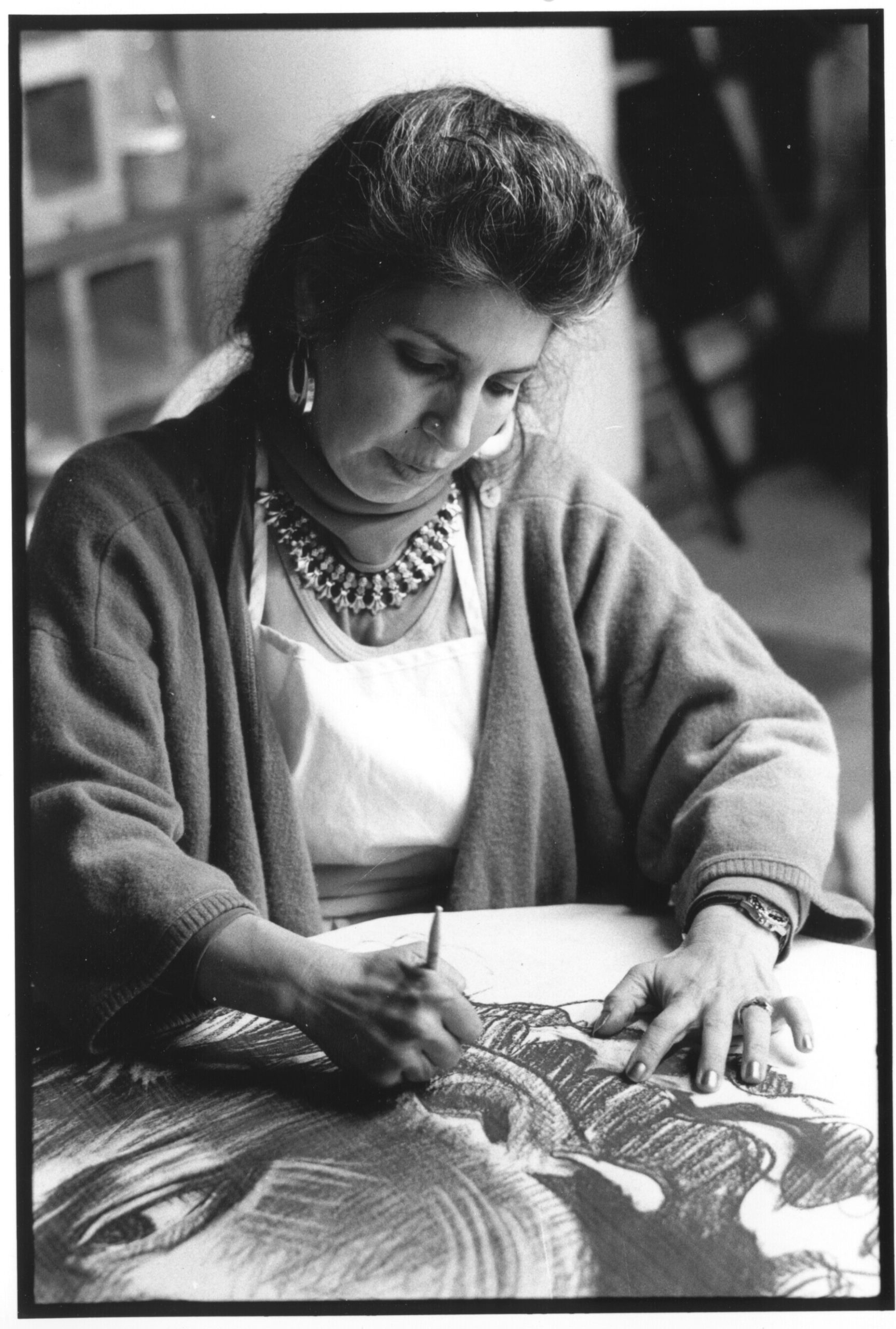
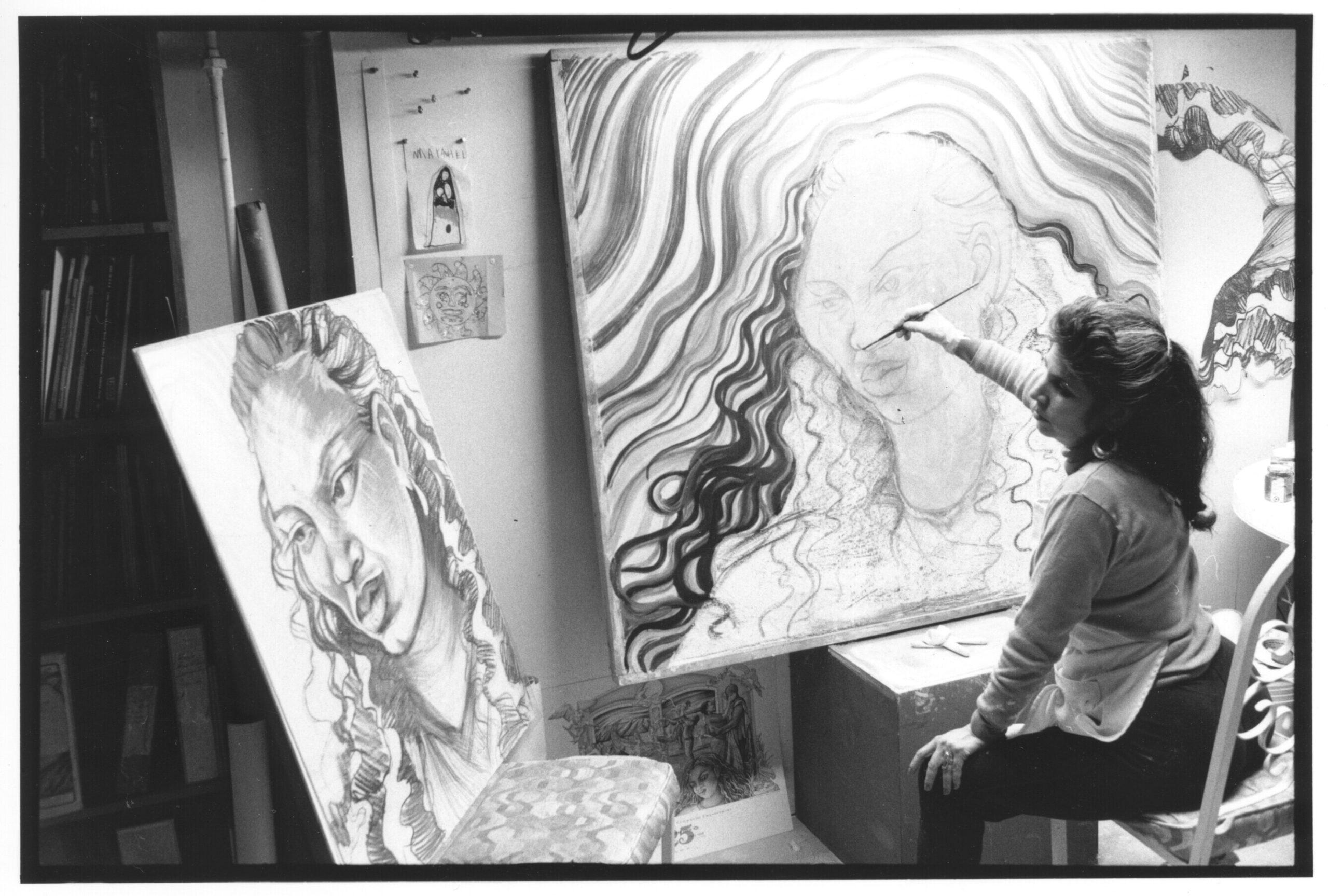
Photo of Juana Alicia’s fresco in progress: Marvin Collins ©1998
Declaración Artistica sobre Murales
© Juana Alicia 2000 World Rights Reserved
Yo hago murales como proyectos colectivos por el proceso de enseñanza que me proveen. Me obliga a pensar y ver por medio de otras mentes y ojos, y a desarrollar mis habilidades de comunicación y capacidades emocionales. También aprendo nuevas técnicas de otros muralistas y artesanos. En obras colectivas, es natural, poder desarrollar obras más monumentales, incluso disminuye la carga de un individuo artista, por medio del hecho que provee relaciones comunitarias, administrativas, documentación y ayuda con la ejecución de la obra.
Individuos adquieren las siguientes habilidades, conocimientos y madurez durante el proceso de la creación de un mural:
- Mejoran la comunicación con sus colegas, maestros, comunidades, y miembros de la prensa
- Habilidades de investigación en búsqueda de recursos de imágenes, historias orales, bibliotecas, recursos de la Red, archivos de fotos, observaciones en sitios-específicos a través de dibujo, fotografía, y video
- Mejoran su capacidad técnica de matemáticas, preparación de presupuestos, recogimiento de fondos, medidas, dibujo, diseño y proyección de imágenes
- El proceso alquímico de la magia de un mural: la unión de una obra monumental por artistas y un proyecto comunitario
En cada instancia de mi experiencia con proyectos colectivos, el cambio que se produce en cada uno de los participantes es increíble. Como mencioné anteriormente, el organismo (el proceso y la obra) en si, toma vida y deja a cada participante cambiado. Obliga aun a los individuos mas difíciles a entregarse a un nivel diferente de conocimiento y una forma diferente de ser o crear. Requiere que confiemos en nuestros colegas y dependamos en los demás para nuestra seguridad y visión. Incluso nos enseña a compartir y a escucharnos mutuamente. Finalmente, nos enseña que cuando dejamos que la sabiduría de un grupo democrático tome poder del proyecto, nos convertimos en artistas y ciudadanos mas concientes.
Los murales afectan a nuestras comunidades al traer un nivel elevado de conciencia a nuestro medio ambiente, convirtiendo nuestras vidas personales, herencias históricas, herencias culturales en imágenes publicas. También revelan esas condiciones en los artistas que las crean para que no sea solo la comunidad la que será representada, pero filtrada por la manera que un artista responde a ella y vise versa.
Con respecto a la posibilidad de efectos negativos en el proceso de un mural colectivo/comunitario, siempre existe la posibilidad de un proyecto que no ha sido investigado ampliamente, donde la comunicación se ha debilitado y en que los miembros se niegan a participar en un proceso democrático y a escucharse mutuamente. La posibilidad de una derrota puede venir a cualquier momento en el proceso creativo porque es un proyecto muy complejo, multidisciplinario y político. Como en cualquier otro proyecto grande/monumental, los murales comunitarios requieren mucha energía, coordinación, cuidado, respeto, amor, y la voluntad de participar en un proceso político que muchas veces es frustrante y difícil. La devoción y dedicación al trabajo son requeridas para crear un resultado positivo.
Foto de la creacion de un fresco por Juana Alicia: Marvin Collins ©1998
About: Biography
I am a muralist, printmaker, educator, activist and painter who loves to draw. I have been teaching for twenty-five years, working in many areas of education, from community organizing to migrant and bilingual education to arts education, from kindergarten to graduate school levels.
I feel that it is my responsibility as an artist to be an activist for social justice, human rights and environmental health, and I see the work of parenting and teaching akin to being an artist. I began working as an artist in my teens, coming of age in the human rights movements that included the United Farm Workers and that protested the war in Vietnam.
I work in many forms and traditions, with a particular dedication to the fresco buono, an ancient painting technique that, practiced all over the world, has endured many centuries. The majority of my public works are in the Bay Area, but I have also painted murals in other parts of the world, including Managua, Nicaragua. Some of my works are individual and others are collaborative.
In 2000 I completed a large fresco mural as part of a collaboration with sculptor and printmaker Emmanuel C. Montoya, who created a bas relief sculpture that surrounds the painting. Entitled “Sanctuary”, this new work is located in Gate Room 99, Terminal G at the newly constructed San Francisco Airport International Terminal. I have also recently completed a mural in Erie, Pennsylvania: A Woman’s Place: As a Warrior in the Struggle for International Solidarity. The work is an expression of the cooperation of two different union organizations: El Frente Auténtico de Trabajadores and the United Electrical Workers Union. Among my most recent work is a ceramic tile mural of the Virgen de Guadalupe, my homage to the Brown Earth Mother of Aztlan. In this case, she is the Virgen de Liberación, with the key to the prisons in her extended hand.
I frequently lecture at Stanford University, San Francisco State University and the University of California at Davis. I have recently completed a new mural on women, water and globalization, entitled La Llorona’s Sacred Waters, located in San Francisco’s Mission District. My current work-in-progress is a suite of bas relief tile murals for the University of California San Francisco Medical Center, on the theme of healing and diversity, which will be installed later this year at the Parnassus Avenue campus, near the Ambulatory Care Clinic.
Foto of Juana Alicia: Victoria Alvarado ©2000
* A project of the San Francisco Art Commission and San Francisco Airport Commission.
En Español
Biografía
Yo soy una muralista, grabadora, maestra, activista y pintora Chicana, a la cual le encanta el dibujo. He trabajado como maestra por más de veinticinco años, en muchas ramas de la pedagogía, desde la organización de comunidades, educación de niños migratorios, programas bilingües, y en la educación de arte, desde el kindergarten al nivel universitario.
Yo creo que es mi responsabilidad como artista luchar para la justicia social, para los derechos humanos y la conservación del medio ambiente. En mi opinion, la enseñanza es un proyecto creativo. Comencé a dibujar y pintar cuando era muy joven, inspirada por los movimientos de derechos humanos y civiles, me involucre en el Sindicato de los Campesinos de César Chavez (United Farmworkers Union), y en el movimiento contra la guerra en Viet Nam.
Trabajo con múltiples formas y tradiciones, con un amor especial hacia la pintura del fresco, una técnica antigua que se ha practicado en todas partes del mundo y ha perdurado por siglos. La mayor parte de mis obras públicas se encuentran en el área de la bahía de San Francisco, California; pero he pintado murales en otras partes incluyendo Managua, Nicaragua. Algunas obras son proyectos individuales y otras son proyectos colectivos o comunitarios.
Hace poco completé un fresco monumental como parte de una colaboración con Emmanuel C. Montoya, un grabador, pintor y escultor que ha creado una escultura en alto relieve que rodea mi mi mural. La obra entera se titula <<Santuario>> y está ubicada en la nueva Terminal Internacional del Aeropuerto de la ciudad de San Francisco. También, acabo de pintar un mural para el Sindicato de Electricistas <<UE>>, en la ciudad de Erie, Pennsylvania. El mural titulado <<El lugar de la mujer: Como una guerrillera en la lucha para la solidaridad internacional>>, la obra es una expresión de la solidaridad entre este sindicato Estadounidense y el Sindicato Colectivo del FAT (Frente Auténtico del Trabajo) de México. Mi obra más reciente es un mural de azulejos que sirve como homenaje al La Virgen de Guadalupe, la madre tierra, Tonántzin de Aztlán. En esta obra, ella representa la liberación, y tiene la llave de las prisiones en la mano extendida, como liberadora de los presos políticos.
Actualmente, vivo y trabajo en la ciudad de Berkeley, California. Enseño en varias universidades, entre ellas: La Universidad de Stanford, La Universidad Estatal de San Francisco y La Universidad de California en Davis. Acabo de completar un nuevo mural sobre la mujer, la globalización y la importancia del agua, en el distrito de la Mission de San Francisco. Mi proyecto actual es un mural de azulejos para el Centro Medico de la Universidad de California en San Francisco. El mural es acerca de el tema de la salud y la diversidad, y será instalado a fines de año en el campus de la Avenida Parnassus, cerca de la Clínica de Salud Ambulante.
Foto de Juana Alicia: Victoria Alvarado ©2000
* Un proyecto de la Comisión de Arte de San Francisco y la Comisión del Aeropuerto de San Francisco.